Creative education has a somewhat contested status in the current school landscape. On one hand, there is widespread agreement that creativity is among the most important qualities for the twenty-first century. On the other, creative subjects are consistently under-resourced, under-timetabled, and under-valued in formal assessment frameworks. The gap between what education policy says about creativity and what it actually does about it remains significant.
What Creativity Actually Is
Creativity is often misunderstood as being primarily about artistic expression. In reality, it is a much broader cognitive capacity: the ability to make new connections, to see problems from unfamiliar angles, to generate multiple possible solutions, and to combine existing knowledge in novel ways. These are not exclusively artistic qualities. They are relevant to science, mathematics, engineering, business, and virtually every other domain of human activity.
The creative process — ideation, experimentation, failure, refinement, and eventual resolution — is structurally identical whether one is composing music, designing a bridge, or developing a business strategy. Teaching children to engage with this process in any creative domain develops cognitive habits that transfer broadly.
The Case for Art in Schools
Visual art education develops observational skills, attention to detail, spatial reasoning, and the capacity to communicate complex ideas without language. Music develops memory, pattern recognition, temporal processing, and emotional expression. Craft develops fine motor skills, patience, and the satisfaction of making something with physical hands. Drama develops empathy, communication, and collaborative intelligence.
Each of these disciplines also develops a particular quality of sustained engagement — the ability to work towards a complex, long-term goal through many intermediate stages of imperfect progress. This is not a small thing.
Supporting Creativity at Home
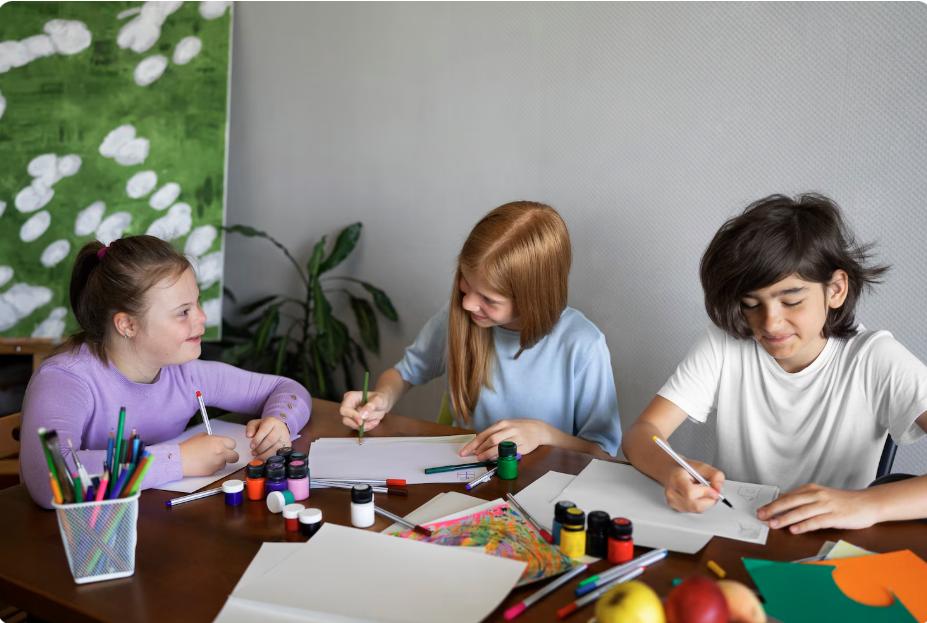
Providing materials and unstructured time is more powerful than providing structured creative activities. A child with paints, clay, old magazines, and time to play will often produce more genuine creative development than one with a kit that prescribes a specific outcome. Resist the temptation to evaluate creative output. Ask about the process instead: ‘How did you decide to do it that way?’ ‘What was the hardest part?’
Parsons Green Prep champions creative education as central to a genuinely rounded childhood. Discover what the school offers at https://www.parsonsgreenprep.co.uk/