Traditional aviation training and education have always been a balancing act in combining theory, practice, safety, and cost considerations. As commercial aircraft systems and infrastructure become more sophisticated, the threshold for operational competency and standards continues to climb. Conventional air training methods alone can no longer provide the depth of learning required.
This is exactly the place where a 3D plane simulator has evolved to become invaluable, revolutionizing the way pilots, students, and aviation professionals learn the skills they require.
By synthesizing authentic aircraft performance data with limitless 3D environments and repeatable scenarios, simulation-based learning aids understanding in ways that reduce time and risk. Whether in universities, flight schools, or professional trainer programs, simulators are now integral to ensuring skill mastery, safety, and consistency.
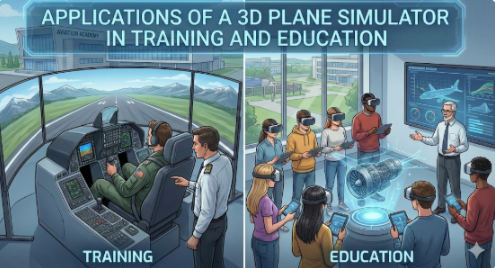
3D Simulator Applications for Aviation Education
In aviation education, there are many complex topics (navigation, meteorology, physics, systems operation, aeronautics, safety procedures, etc.) that need to be understood at a theoretical level long before students can understand the jet they eventually fly.
Simulation technology enables students to observe core theories to be put into practice. Students can learn exactly how altitude changes affect fuel consumption and aircraft controls, how subtle movements lead to changes in aircraft attitude, and how a pilot perceives weather using stand, in conditions. Rather than abstract information from books and lectures, students experience key concepts visually while learning.
Training Benefits for Early-Stage Pilot Instruction
Every beginning student pilot finds certain familiarization stages to be daunting. Managing controls, taking directional cues, monitoring the altitude and speed, and following checklists all at once can be difficult.
Simulation-based training programs allow these new pilots to practice basic tasks in a stress-free environment. Taxiing, traffic circuits, hover training, and even autopilot management can be mastered efficiently and safely.
Heavy repetition helps build confidence before transitioning to an aircraft.
Enhancing IFR Pilot Training
Instrument landings, navigation, and approach steps are usually some of the most difficult training components for pilots to perfect.
Simulation provides the perfect incubator for IFR altitude and approach procedures. Learners can practice in controlled visibility during engine failures, simulated adverse weather, or other anomalies.
Pilots who train in this way develop a natural hand accuracy with IFR steps and procedures, readying them for real-world demand.
Simulation is also a risk-free, flexible way to simulate extreme weather and unfamiliar terrain challenges.
Practicing Emergency Handling in a Simulated Environment
Procedures for failures and system emergencies are of paramount importance to pilots, but they are also inherently unsafe to train repeatedly in real aircraft.
Simulation allows this kind of training to be conducted without external risk. Everything from simultaneous engine failures to working airbags, equipped seats to emergency landings can be rehearsed repeatedly until perfect. Training scenarios can be paused, restarted, and altered dynamically.
Effective simulation ensures a pilot’s response is second nature when it matters.
Standardizing Training Conditions for Schools
One of the pitfalls of aviation education is inconsistent training because of instructor style, aircraft scheduling, or weather.
Simulation offers the chance to create predetermined scenarios that every student can experience in a uniform way. This consistency enhances grading, certifies a standardized skill set, and makes course administration more straightforward.
Simulation-based curricula can be more easily tailored and repeatedly administered across student cohorts.
Repetition is Key to Skill Development
In aviation, cars can’t be driven enough times; real-world practice is costly, limited, and weather-dependent. The more you do it, the better you get.
Simulation enables this to be done virtually. Students can approach the same course or maneuver repeatedly without limit or risk. This helps develop muscle, memory, avoid bad habits, and intensify the learning of complex skills.
Simulation-based repetition provides enormous time and logistics advantages for skill reinforcement.
Applications in Advanced & Corporate Education
In addition to basic aviation learning, simulation is a primary component in ongoing pilot training, such as recurrent training, initial cross-training, over-training to new aircraft types, and proficiency improvement modules.
Pilots learn how to handle multi-crew situations, workload management, seniority intra, crew training, and abnormal operations in a simulated, non-pressurized setting.
Long-term simulation supports a pilot’s continuing education throughout their career.
Enabling Better Instructor Feedback
Off-the-shelf simulator visuals give instructors an objective set of factors in analyzing trends and testing improvements.
Reviewing flight data can highlight subtle areas for improvement or particularly effective techniques.
This allows the teaching process to be less subjective and translates into enhanced learning. Educators can instruct based on graphs, focus on more targeted teaching points, and streamline the whole experience.
This ultimately translates into safer, more knowledgeable pilots.
Cost, Saving Benefits of Simulation
Aviation school expenditure can be enormous. Between fuel, maintenance, student numbers, and insurance, costs are high.
Simulation reduces costs by allowing institutions to provide additional practice scenarios in a virtual realm. Cost savings for schools can be passed on to learners, and learners can use simulation to increase training hours relative to actual seat time.
Cost reductions make training more feasible while keeping precision high.
Bringing High Tech Trends to Education
In modern aviation, aircraft are literally controlled by complex IT systems, not just classic pilots’ switches and levers.
Simulator use prepares students to manage FMS units, glass cockpits, and digital instrumentation. This will ease their transition to actual aircraft and carry into their commercial aviation careers.
Simulation can be the ultimate training investment for technologically advanced training programs.
Visuals as a Pedagogic Tool
Simulation is built on the visual development of an authentic simulation of real-world conditions.
Accurate, synchronized high-quality visuals foster realism and engagement in the application. They also help garner better attention, trust, and willingness to learn from students.
Partnership with the right 3D visualization company can be decisive.
Conclusion
Simulation is taking an increasingly important position in aviation training and education. It supports skills development across the entire journey from initial ground school to pilot recurrency and type-specific training.
In this capacity, a 3D plane simulator allows an aspirant or professional pilot to learn anytime, anywhere in safe environments that enrich learning, standardize instructor quality, save time and money, and prepare for all possible eventualities.
When paired with authoritative visual design, simulation becomes a best practice that can be relied upon for years to come.
